House pads and site prep in Warner Robins and Houston County
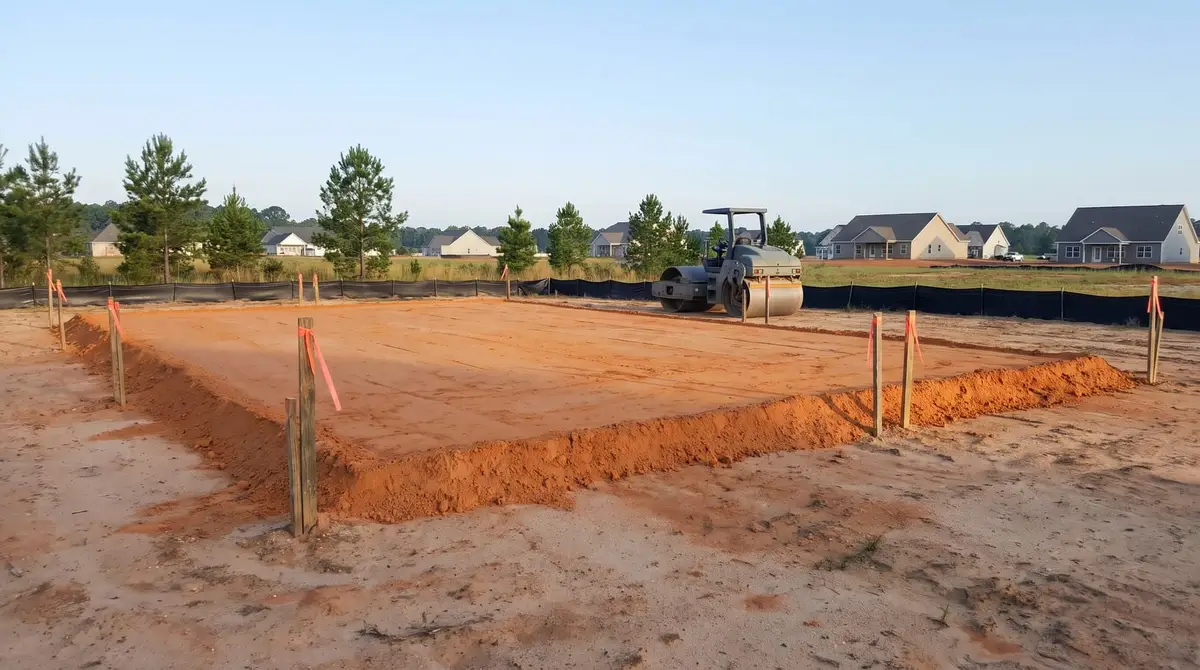
A new house needs a firm, level pad that sits high enough for water to drain away from it. On the flat lots common around Warner Robins and Perry, that usually means building the pad up with fill and packing it in thin layers, rather than cutting into a hillside.
Call (478) 339-4999Rather not call? Send the detailsCalls are answered weekdays, 9 to 6. After hours, leave your name, address and what's going on, and you'll get a call back first thing the next business day.
What does site prep for a new home involve?
- Clear: Trees, brush, stumps and topsoil come off the house footprint and the drive.
- Bring in fill: Clean fill dirt is hauled in to raise the pad above the ground around it.
- Compact in layers: Fill goes down in thin lifts, each packed and wetted as needed before the next, so the pad doesn't settle under the slab.
- Shape for drainage: The pad's edges fall away on every side, and the yard is graded so water has a path off the lot.
- Construction entrance: A stone pad at the road keeps trucks from tracking mud into the street.
Why build the pad up on a flat lot?
Because on flat ground the only way to get the 6 inches of fall in the first 10 feet that the code asks for is to start higher. A slab poured level with the yard has nowhere to send water but toward itself.
The fill has to be packed well. Loose fill keeps settling for years, and under a house that means cracked slabs and sticking doors. Your builder or engineer may set how the pad is compacted and tested; give those notes to the grading crew.
What if the lot is in a floodplain?
Houston County requires a development permit before any work in a mapped floodplain. For new homes there, the county's ordinance sets the lowest floor at least 36 inches above the base flood elevation, which is stricter than the federal minimum. Confirm the current requirement with the county for your lot.
Lots near creeks and in the low ground toward the Ocmulgee River are the ones most likely to be affected. Ask for the flood map for your lot before the pad height is set.
Do I need a land-disturbance permit?
Houston County issues land-disturbance permits under the state's rules. A permit is generally needed at one acre or more, or for smaller work that is part of a larger development or within 200 feet of a year-round stream. Most lots in new subdivisions are part of a larger plan, so the developer's permit and erosion rules usually apply.
Inside Warner Robins, Perry or Centerville, check with the city as well as the county.
How much does site prep cost?
HomeGuide's national excavation figures put a foundation pad for a new home at $1,500 to $10,000, with general excavation at about $2.50 to $15 a cubic yard. On flat lots, the amount of fill trucked in is usually the biggest line.
Ask for clearing, fill, compaction, the construction entrance and any hauling as separate lines.
Common questions
How high should the pad be?
High enough that the finished ground falls away from the house on every side, and above any flood elevation that applies. The builder or surveyor sets the exact height.
How long does a house pad take?
A few days on an open lot, longer with heavy clearing or a lot of fill. Wet weather stops compaction work.
Can I use the dirt from my own lot?
Sometimes, if it's clean and packs well. Topsoil, roots and soft clay should not go under a slab.
Sources: Houston County, Water Resources Protection Ordinance, flood damage prevention (full-text copy) (source); Houston County, Water Resources Protection Ordinance (2019): erosion permits and the Ocmulgee River corridor (source); International Residential Code 2024, R401.3 Drainage (adopted in Georgia with amendments) (source); Georgia 811, the 811 process (source); HomeGuide, Excavation cost (Feb 2026) (source).
Last reviewed November 2, 2026.
Rather not call? Send the details
A local grading pro will call you back.