French drains for wet yards in Warner Robins and Houston County
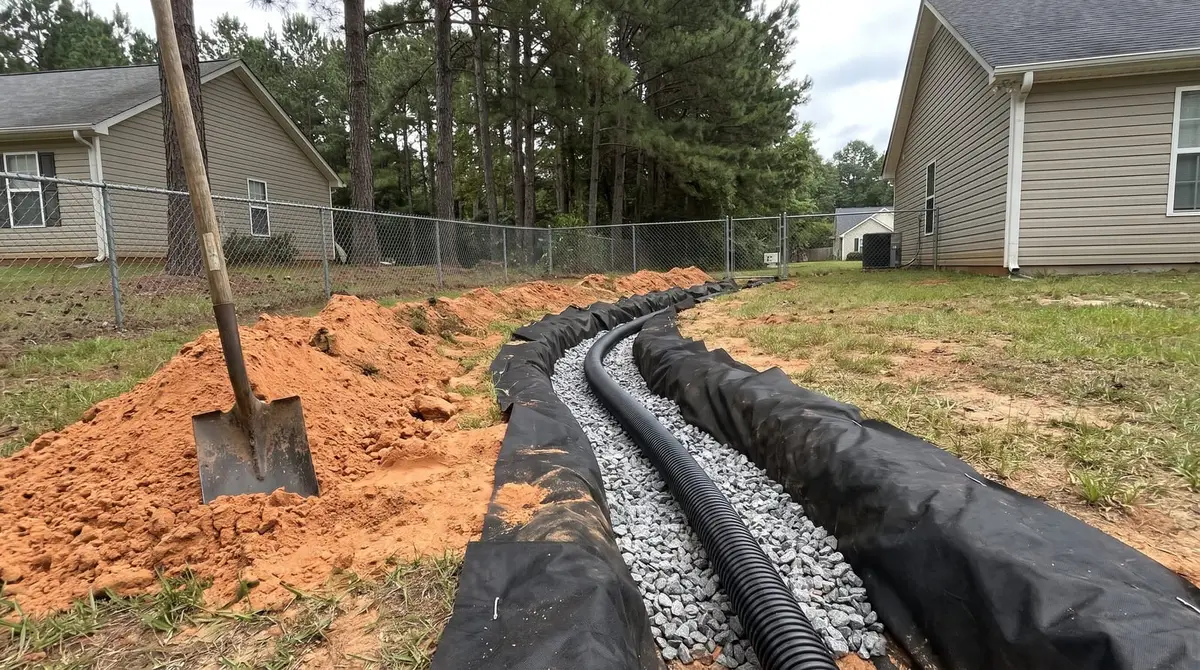
A French drain is a trench of washed gravel around a perforated pipe that gathers water from a wet patch and carries it to a lower spot. On the flat lots around Warner Robins, finding that lower spot is most of the job. Installed drains often cost $10 to $35 a foot.
Call (478) 339-4999Rather not call? Send the detailsCalls are answered weekdays, 9 to 6. After hours, leave your name, address and what's going on, and you'll get a call back first thing the next business day.
When is a French drain the right fix?
When the ground can't simply be reshaped to drain. Common cases here: a backyard that is lower than the lots around it, a strip between two houses where water collects, a patio or slab with wet ground along its edge, or a yard where the sandy topsoil stays saturated over a layer of clay.
If the yard just slopes toward the house, grading comes first. A drain earns its keep when water has to travel underground to reach a way out.
Where does the water go on a flat lot?
A French drain is only as good as its outlet. On flat ground, the usual choices are:
- The street or a roadside ditch: Often the lowest point near the house. The pipe ends at the curb or the ditch bank.
- The back of the lot: Where the lot falls toward a ditch, a wooded strip or a drainage easement.
- A dry well: A buried gravel pit or chamber that holds the water while it soaks into sandy soil. It works best where the ground is sandy all the way down, not on clay or a high water table.
- A pop-up emitter: A small cap in the lawn that lets water out at the surface once the pipe has carried it away from the house.
The pipe needs a steady downhill run the whole way, even if it's only a fraction of an inch per foot. Without any fall, the drain fills and stays full.
How is a French drain built?
- Plan the run: The crew picks the route and outlet, checks the fall between them, and has buried lines marked through Georgia 811 at least 3 business days ahead.
- Trench: A trencher or mini excavator digs the trench, tilted toward the outlet.
- Wrap and fill: Filter fabric lines the trench, a bed of gravel goes in, then the perforated pipe, then more gravel.
- Finish: The fabric folds over the stone so sand can't wash in, then soil and sod or a decorative gravel strip go on top.
Are there limits on where I can drain water?
Don't aim it at a neighbor's yard. Georgia also protects a 25-foot buffer along the banks of state waters, so a drain that outlets into a creek bank is a bigger job with its own rules.
Many Houston County creeks are lined with Bibb soils, which the USDA describes as poorly drained, with a water table close to the surface for much of the year. A drain that empties into that ground often has nowhere to go during wet months.
How much does a French drain cost in Houston County?
HomeGuide's national 2026 figures put French drains at $10 to $35 a linear foot, or about $500 to $8,800 for a full install. The long run to a distant outlet, a dry well, the depth, and putting the lawn back afterward are the big variables.
Have the length, depth, pipe type, fabric and outlet spelled out in each quote so you're comparing the same job.
Common questions
Will a dry well work in my yard?
In deep sand, often yes. Over a clay layer or near a creek where the water table is high, it can fill and stop draining, so a dig test first is worth it.
How long will a French drain last?
Many years if it has filter fabric and an outlet that stays open. Sand in the gravel and roots in the pipe are what usually end one early.
Can a French drain run beside the slab?
Yes, drains along a foundation are common. They still need to carry the water away to a lower outlet.
Can I put one in myself?
A short, shallow run with an easy outlet is a reasonable DIY job. Call Georgia 811 at least 3 business days before digging, use fabric, and check the fall with a level. Long runs and deep trenches go faster with a crew and a trencher.
Sources: Georgia 811, the 811 process (source); Georgia EPD, Buffer mitigation guidance (25-foot state waters buffer) (source); USDA NRCS, Official soil series description: Bibb (source); Houston County, Water Resources Protection Ordinance (2019): erosion permits and the Ocmulgee River corridor (source); HomeGuide, French drain cost (Feb 2026) (source).
Last reviewed November 2, 2026.
Rather not call? Send the details
A local grading pro will call you back.